6-minute read
Deep Dish Japan Style
Best served with semi-slick tyres, Japan’s back-catalogue of iconic wheel sets caters to every kind of build. SSR’s pioneering three-piece wheel design in 1971 set an early benchmark, helping define a new era of modular wheel construction that Japanese manufacturers continue to refine today.
Japan’s emerging wheel industry was shaped by rapid motorsport development in the late 1960s, where lightweight wheel design was driven by engineering practicality, competition regulations and the manufacturing constraints of the period. During this era, the 8-spoke format — established by Hayashi Racing and Watanabe — became a defining solution, balancing strength, reduced unsprung weight and brake cooling efficiency.
Emerging as the industrial backbone of large-scale wheel production in Japan, Enkei’s origins can be traced back to post-war industrial conversion, where engineering expertise in aluminium casting was redirected into civilian manufacturing following the GHQ ban on aircraft production.
Building upon the popularity of the 8-spoke designs established throughout the 1960s, the Mini Specialist Association sought to develop an original wheel of its own. With copyright concerns surrounding the Minilite design remaining an ongoing issue, the project required a distinctive visual identity while retaining the familiar motorsport-inspired proportions enthusiasts had come to associate with the era.
According to the original designer, inspiration was ultimately drawn from the anime character Alien Baltan of Ultraman, with the shape of the character’s head influencing the wheel’s final spoke design. The resulting design blended period-correct styling with a uniquely Japanese interpretation of the traditional 8-spoke format.
Enkei would later refine the design for production and oversee manufacturing, with the most sought-after specification becoming the limited-edition twin-valve variant, restricted to just 100 sets. Intended primarily for circuit use, the twin-valve configuration was designed to facilitate the use of nitrogen inflation in place of compressed air, helping maintain more stable tyre pressures under sustained track conditions.
Though period wheel sets are increasingly difficult to source, their influence remains deeply embedded within Japan’s Mini culture, featuring prominently at both monthly meet-ups and larger annual events. As demand continues to outweigh the availability of genuine period examples, sourcing original sets in desirable condition has become progressively more challenging within the secondary market.
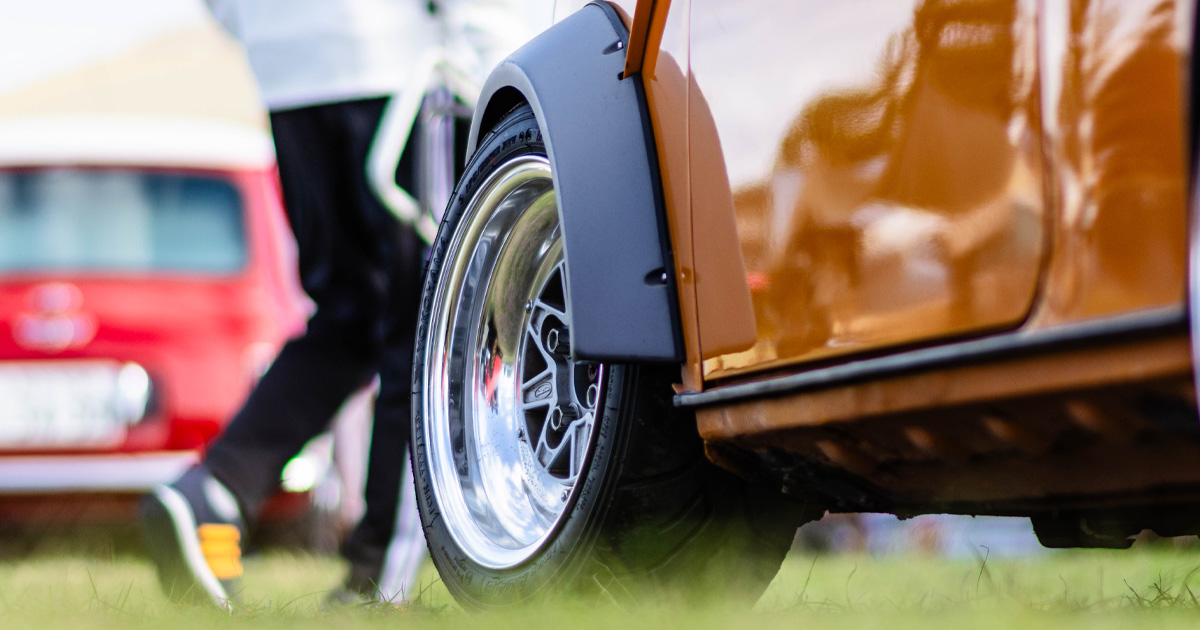
Thankfully, more than half a century on from Japan’s original wheel pioneers, several iconic designs remain in production today. In particular, RS Watanabe’s traditional sand-cast manufacturing process continues to contribute to the distinctive surface finish and organic spoke profiles closely associated with the design. While period-correct narrow wheels continue to retain a loyal following, wider and more aggressive fitments have increasingly come to define the current Japanese Mini scene.
The continued popularity of timeless classics — including the SSR FLII, RS Watanabe, Spectrum Racing and Volks Racing — now sits alongside an increasing demand for wider and more aggressive fitments, with modern wheel designs regularly extending to 7 inches in width. Frequently paired with locally manufactured FRP arches, our recently released BR-010 wheel set represents a contemporary interpretation of the wider fitment philosophy that continues to shape the current generation of Japanese Mini builds.
Copyright © 2026. Classic Minis Japan